

WHAT GRUNGE
PHOTOGRAPHY
CAN'T DO
2024-08-23
Nour Tournier
Nour Tournier
© DORIAN LAFARGUE
(1) Juergen Teller - 29 october 1998 © Juergen Teller
(2) Jamie Morgan - Buffalo, Killers serie © Jamie Morgan
© DORIAN LAFARGUE
(1) Corinne Day - Rose on Orange Sofa, from ‘England’s Dreaming’, The Face, August 1993 © The Corinne Day Archive
(2) Terry Richardson, Rats at the Ritz campaign staring Denis Lavant for Enfants Riches Déprimés SS25 © Terry Richardson
© DORIAN LAFARGUE
WHAT GRUNGE
PHOTOGRAPHY
CAN'T DO
2024-08-23
Nour Tournier
The end of the twentieth century carried the fatigue of failed revolutions, steering a postmodern flight into spectacle. These were Guattari’s “winter years.” Aspirations for radical change were stifled, while popular discourse increasingly reinforced existing power structures. In fashion, this took form in glamour, perfectly embodied in its alienating photography, obsessed with plastic perfection and consumerist desire. Yet these same years also became incubators for transformative forms of resistance emerging from the margins. Grunge stood as a counterforce; these were the great years of the underground. Four decades later, what remains? Subversive mood boards and the self-celebration of chic rebels? We have to look elsewhere.


(1) Juergen Teller - 29 october 1998 © Juergen Teller
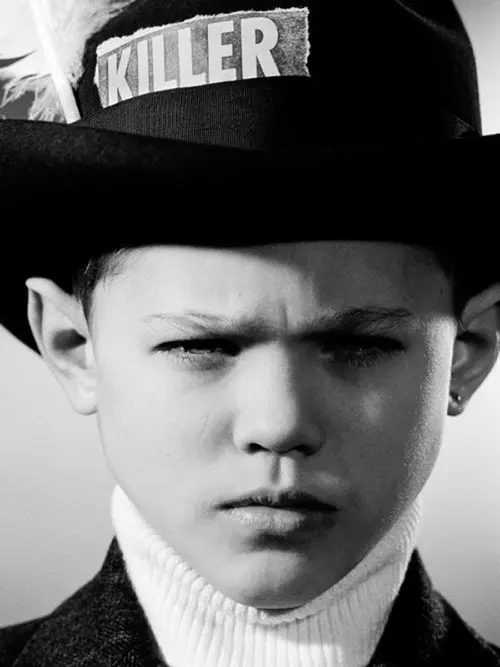
(2) Jamie Morgan - Buffalo, Killers serie © Jamie Morgan
In 1981, a Figaro reporter described Rei Kawakubo’s clothes, shown in Paris for the first time, as “apocalyptic creations (…) as if worn by survivors of a nuclear holocaust.” Her silhouettes — alongside those of Yohji Yamamoto — opened the way to new definitions of elegance and sexuality, to which buyers were quick to respond. Designers, too. These early collections became a major reference point for the emerging Belgian designers of the Royal Academy of Fine Arts in Antwerp.
Across the Channel, young London creatives gathered in the legendary clubs of Covent Garden. Students from Saint Martins School of Art and the Royal College of Art came for the music, but above all for their sartorial performances. Their intense will to fashion — highly selective, almost elitist — stood in opposition to punk, yet constantly referred back to it. Everywhere, a fashion avant-garde was probing a new relationship to spectacle, and to its contestation.
However, these periods cannot be limited to mere despair. On the contrary, they are the breeding grounds for transformative seeds of resistance originating from the fringe. The now-legendary designers Rei Kawakubo and Yohji Yamamoto brought about a radical renewal in Paris starting in 1981, proposing an aesthetic of deliberate pauperism. A reporter from Le Figaro described Kawakubo’s clothes as “An apocalyptic creation (...) as if worn by survivors of a nuclear holocaust.” Their silhouettes paved the way for new definitions of elegance and sexuality, to which buyers quickly responded. Designers too: these early collections constituted a major reference point for the new Belgian designers from the Royal Academy of Fine Arts Antwerp, the Antwerp Six, and especially, for Martin Margiela. A fashion avant-garde thus questioned a new relationship with spectacle. The photography of these new creators, integrated into a parallel discourse to the superficial world that reigned, became the substance of a global artistic project.
Benefiting from new media structures such as The Face and Blitz, a photography inspired by documentary and punk favored an aesthetic more akin to documentary photography than studio work: humility of means and technical poverty were embraced in favor of an aesthetic of the instant, a realistic one. Figures like Jamie Morgan (and the Buffalo aesthetic), Wolfgang Tillmans, Juergen Teller, or Corinne Day no longer promoted a style that was a matter of money. Musical Lo-Fi found its full echo in grunge. The entire reference system became politicized with anti-capitalist affiliations, the valorization of rave counter-culture and associated consumption, and a new approach to gender issues.
This “grunge” photography, while aesthetically divergent, became politicized through anti-capitalist affiliations, the valorization of multiple countercultures and their illicit forms of consumption, and a renewed approach to questions of gender. An international community of the margins crystallized, sharing a violent creative energy — intoxicated by new playgrounds, new tools, new voices to be opened. And yet… “Everything is cycle, vicious circle, eternal return,” Morgan Sportès observed in his novel Solitudes. One must admit that many of these figures of alternative photography were directly co-opted by the mainstream press as early as the beginning of the 1990s — Fabien Baron at Harper’s Bazaar, for example, contracting David Sims, Mario Sorrenti, or Glen Luchford. Their projects began to turn profitable, working hand in hand with stylists attuned to their aesthetics.
The aspirations of fashion and its photography shifted from reflecting the haute bourgeoisie — embodied by an idealized, classicizing beauty — toward a diversification through the street, youth, and inventiveness in the face of a tempo of change now dictated by industry. This marked a first stage of recuperation by the system. The ongoing digital revolution allowed a second wave of independent publications (Purple, Self Service, Dutch, Big, and Visionaire) to enjoy a few years of relative autonomy, but the turn of the twenty-first century reshuffled the deck.
WHAT GRUNGEPHOTOGRAPHYCAN'T DO


This “grunge” photography, while aesthetically divergent, became politicized through anti-capitalist affiliations, the valorization of multiple countercultures and their illicit forms of consumption, and a renewed approach to questions of gender. An international community of the margins crystallized, sharing a violent creative energy — intoxicated by new playgrounds, new tools, new voices to be opened. And yet… “Everything is cycle, vicious circle, eternal return,” Morgan Sportès observed in his novel Solitudes. One must admit that many of these figures of alternative photography were directly co-opted by the mainstream press as early as the beginning of the 1990s — Fabien Baron at Harper’s Bazaar, for example, contracting David Sims, Mario Sorrenti, or Glen Luchford. Their projects began to turn profitable, working hand in hand with stylists attuned to their aesthetics.
The aspirations of fashion and its photography shifted from reflecting the haute bourgeoisie — embodied by an idealized, classicizing beauty — toward a diversification through the street, youth, and inventiveness in the face of a tempo of change now dictated by industry. This marked a first stage of recuperation by the system. The ongoing digital revolution allowed a second wave of independent publications (Purple, Self Service, Dutch, Big, and Visionaire) to enjoy a few years of relative autonomy, but the turn of the twenty-first century reshuffled the deck.
This “grunge” photography, while aesthetically divergent, became politicized through anti-capitalist affiliations, the valorization of multiple countercultures and their illicit forms of consumption, and a renewed approach to questions of gender. An international community of the margins crystallized, sharing a violent creative energy — intoxicated by new playgrounds, new tools, new voices to be opened. And yet… “Everything is cycle, vicious circle, eternal return,” Morgan Sportès observed in his novel Solitudes. One must admit that many of these figures of alternative photography were directly co-opted by the mainstream press as early as the beginning of the 1990s — Fabien Baron at Harper’s Bazaar, for example, contracting David Sims, Mario Sorrenti, or Glen Luchford. Their projects began to turn profitable, working hand in hand with stylists attuned to their aesthetics.
The aspirations of fashion and its photography shifted from reflecting the haute bourgeoisie — embodied by an idealized, classicizing beauty — toward a diversification through the street, youth, and inventiveness in the face of a tempo of change now dictated by industry. This marked a first stage of recuperation by the system. The ongoing digital revolution allowed a second wave of independent publications (Purple, Self Service, Dutch, Big, and Visionaire) to enjoy a few years of relative autonomy, but the turn of the twenty-first century reshuffled the deck.
(1) Juergen Teller - 29 october 1998 © Juergen Teller
(2) Jamie Morgan - Buffalo, Killers serie © Jamie Morgan
A deeply depressive climate left creators with the bitter aftertaste of failed revolutionary breaks. Some opted for radical refusal and an exit from the creative system. Yet the permission to survive granted by the fashion industry drove most to join the official sphere. The arrival of the internet, followed by social media in the mid-2000s, re-amplified this movement of generalized vampirization. Capital displaced the underground from the margins, reconstituting it as a resource for development. The early anti-spectacular aesthetic became subject to further co-optation through its becoming-image. Grunge evolved. Violence turned inward. Self-directed malaise replaced the combative revolutionary spirit of trash punk.
A growing need to “make real” — as much analog as digital — to show what remains of intimacy and spontaneity, began to assert itself. The incursion of a personal, fluid mode of storytelling came to characterize photography once labeled “anti-fashion”: snapshot, heroin chic, and other derivatives accompanied the entry into the twenty-first century. The era placed the subject in a new relation to the self which, without shedding its consumerist, depressive, and controlled obligations, became tied to a new duty of public self-representation — the performance of the instant, perfectly suited to the digital cause, an image-driven enthusiasm for capital that had until then been confined, almost unconsciously, to a handful of celebrities.


(1) Corinne Day - Rose on Orange Sofa, from ‘England’s Dreaming’, The Face, August 1993 © The Corinne Day Archive
(2) Terry Richardson, Rats at the Ritz campaign staring Denis Lavant for Enfants Riches Déprimés SS25 © Terry Richardson
What persists throughout this imagery is a gaze fixed on a world of simulacra — more or less in denial of its condition, more or less reflexive in its ignorance of the omnipresence of financial power. Today, we are voyeurs: of a latent, commodified eroticism, and of the generalized artificialization of all political discourse carried through expressions of beauty. This shift in values has distanced us from the contemporary. Every delicate aesthetic offshoot is immediately seized upon by image producers for its potential to differentiate. Even as our society is constantly described as ruled by images, photographs have far less impact, reduced to the status of ordinary events.
What might allow us to truly see again — to grasp the potential of the visual — would be an additional surge of creative energy. Among many of us remains a desire to make something different, like a fantasy of the originary. A few succeed, for a handful of inspired months. But the avant-garde cannot distinguish itself through aesthetic renewal alone. It must exercise a self-reflexivity that extends beyond form. What we desperately need are courageous consciousnesses.
What persists throughout this imagery is a gaze fixed on a world of simulacra — more or less in denial of its condition, more or less reflexive in its ignorance of the omnipresence of financial power. Today, we are voyeurs: of a latent, commodified eroticism, and of the generalized artificialization of all political discourse carried through expressions of beauty. This shift in values has distanced us from the contemporary. Every delicate aesthetic offshoot is immediately seized upon by image producers for its potential to differentiate. Even as our society is constantly described as ruled by images, photographs have far less impact, reduced to the status of ordinary events.
What might allow us to truly see again — to grasp the potential of the visual — would be an additional surge of creative energy. Among many of us remains a desire to make something different, like a fantasy of the originary. A few succeed, for a handful of inspired months. But the avant-garde cannot distinguish itself through aesthetic renewal alone. It must exercise a self-reflexivity that extends beyond form. What we desperately need are courageous consciousnesses.
© DORIAN LAFARGUE


