

ALISSON
ROSSITER
INTERVIEW
2026-02-27
Nour Tournier
Nour Tournier
© DORIAN LAFARGUE
(1) Alison Rossiter, Semblance, Man Ray Tapestry, 2025, Sixteen Gelatin Silver Prints, 4 1/4" x 3 1/4" (11 x 8 cm), 17" x 13" (43 x 33 cm), Unique
(2) Alison Rossiter, Eastman Kodak Azo Hard C Grade, expired November 1917, processed 2010 (#2)
2010, gelatin silver print, 35.5 × 43 cm (14 × 16 15/16 in.)
© DORIAN LAFARGUE
(1) Alison Rossiter, Ray Metzker's Agfa Brovira, 1970S (#4), 2020, Gelatin Silver Print, Framed: 53 7/8” x 55” (136.5 x 139.5 cm)
(2) “Defender Argo, expired September 1911, processed 2014”, (#6), 2014, unique silver gelatin print, 12.70 x 17.78 cm © Alison Rossiter, Courtesy Yossi Milo Gallery, New York
© DORIAN LAFARGUE
ALISSON
ROSSITER
INTERVIEW
2026-02-27
Nour Tournier
American artist Alison Rossiter no longer takes any photographs. Yet it is as a photographer that she features in some of the most prominent contemporary collections, including MoMA, the J. Paul Getty Museum, the National Gallery of Art in Washington, and the National Gallery of Canada in Ottawa. Born in Mississippi in 1953 and trained at the Rochester Institute of Technology, this former teacher and conservator chose to abandon the camera, the lens, and the subject. In the face of digital hegemony, she tracks down forgotten lots of light-sensitive paper on eBay, some expired as far back as 1898. Mold, alterations in silver salts, and the marks of time give rise to minimalist abstractions of alchemical beauty. By offering an image without an author—where paper becomes a thing in itself—Alison Rossiter wages a poetic battle against time, decay, and the death of the analog medium. Interview.



(1) Alison Rossiter, Semblance, Man Ray Tapestry, 2025, Sixteen Gelatin Silver Prints, 4 1/4" x 3 1/4" (11 x 8 cm), 17" x 13" (43 x 33 cm), Unique
(2) Alison Rossiter, Eastman Kodak Azo Hard C Grade, expired November 1917, processed 2010 (#2)
2010, gelatin silver print, 35.5 × 43 cm (14 × 16 15/16 in.)
NOUR TOURNIER: By choosing expired, obsolete papers or materials discarded from commercial channels, do you consider your gesture a form of withdrawal, or even a protest against the acceleration of visual consumption?
ALISON ROSSITER: I stepped away from the contemporary state of visual imagery the day I discovered the possibilities offered by developing expired silver gelatino-bromide photographic papers. From then on, my focus shifted to these papers, while the digital visual field followed a different trajectory. I use my skills as a 20th-century-trained photographer to work with these expired papers. 20th-century silver-based photographic materials do indeed continue to react to developer in the 21st century. My oldest papers no longer yield figurative images from negatives; they render only shades of black, gray, cream, and white. This reduced palette offers me a new mode of expression. In it, I discover marks left by atmospheric conditions that have affected the light-sensitive emulsions. These accidental alterations produce what I consider to be abstract imagery. My prints thus become records of time. I have developed two distinct approaches to working with these old papers. In the first, I develop the sheets straight out of their packaging to observe what time has done to the material. I am seeking to see what these papers have lived through. In the second, I intervene more deliberately by selectively developing specific areas of the paper's surface.
TOURNIER: Does this refusal to produce, in favor of upcycling, represent a radical aesthetic position for you—a kind of degree zero of creation?
ROSSITER: My photographic path changed abruptly in 2007, when I brought a 61-year-old piece of photographic paper back to life. The first box came to me by chance in an eBay shipment containing expired sheet film. I had never intended to buy old paper; that box of Eastman Kodak Kodabromide E3, which expired on May 1, 1946, was sent to me as an unexpected gift from the seller. When I tested the sheets from that box, I realized immediately that I had discovered an extraordinary source of abstract photographic imagery, produced by the action of time on a light-sensitive material. The test prints were remarkable: one evoked a graphite drawing by the artist Vija Celmins, while another reminded me of the first known photograph made by Nicéphore Niépce in 1828. That single day in the darkroom marked the beginning of my work with expired silver papers. The test prints were "found" abstractions.
I then frantically began buying more expired photographic papers online. I put my cameras away and let myself be guided by the papers themselves. I am convinced that every package of old paper holds the potential to yield latent images over long periods of storage. Standard chemical development makes these latent traces visible. When a sheet of expired paper is processed, it reveals itself for the very first time in its existence. On occasion, I discover the fingerprints of the last person to handle a sheet of paper in a darkroom decades earlier. A trace amount of sebum left on the fingers is enough to disrupt the light-sensitive emulsion and leave a clear print upon development. Whenever I come across such a mark, I pause, struck by the thought of that last human contact with the surface of the paper.
TOURNIER: Is there an ecological or political dimension to your work? How do you view the relationship between art and politics?
ROSSITER: The expiration dates printed on paper packages invite a political reading. I research those years to understand what was happening in the world at that specific moment. I have thus processed the papers in my collection in chronological order, assembling the prints like points along a timeline stretching from the 1890s to the present day. The titles of my works list three pieces of information: the manufacturer and brand, the expiration (or production) date, and the processing date. For example: Eastman Kodak, Kodabromide E3, expired May 1, 1946, processed 2007. I place particular emphasis on the time gap between the expiration date and the processing date. When I assemble prints dated from 1914 to 1918, I think about the years of the Great War in Europe. 1918 also marks the start of the Spanish Flu pandemic. My prints thus serve as material evidence of a distant past: the papers already existed at the time of these events and survived to be used a century later. Papers made in the United States often carried precise expiration dates because manufacturers promised a free replacement in the event of a manufacturing defect. European manufacturers, on the other hand, generally did not adopt this commercial strategy.
TOURNIER: Are you seeking to build a bridge to the history of photography?
ROSSITER: My collection, which gathers papers from every decade of the 20th century as well as the 1890s, has made me keenly aware of the history of industrial production of photographic materials. Corporate history and scientific history progress alongside the history of photography. Technical advancements influenced the appearance of photographic prints in every decade. When I process papers from the 1930s, I think of the photographers who might have used those same materials in their darkrooms: Dorothea Lange photographing the effects of the Great Depression in the United States, or Brassaï capturing Paris by night. Through these papers, I imagine my counterparts from the past.
ALISSON ROSSITER INTERVIEW


TOURNIER: Is there an ecological or political dimension to your work? How do you view the relationship between art and politics?
ROSSITER: The expiration dates printed on paper packages invite a political reading. I research those years to understand what was happening in the world at that specific moment. I have thus processed the papers in my collection in chronological order, assembling the prints like points along a timeline stretching from the 1890s to the present day. The titles of my works list three pieces of information: the manufacturer and brand, the expiration (or production) date, and the processing date. For example: Eastman Kodak, Kodabromide E3, expired May 1, 1946, processed 2007. I place particular emphasis on the time gap between the expiration date and the processing date. When I assemble prints dated from 1914 to 1918, I think about the years of the Great War in Europe. 1918 also marks the start of the Spanish Flu pandemic. My prints thus serve as material evidence of a distant past: the papers already existed at the time of these events and survived to be used a century later. Papers made in the United States often carried precise expiration dates because manufacturers promised a free replacement in the event of a manufacturing defect. European manufacturers, on the other hand, generally did not adopt this commercial strategy.
TOURNIER: Are you seeking to build a bridge to the history of photography?
ROSSITER: My collection, which gathers papers from every decade of the 20th century as well as the 1890s, has made me keenly aware of the history of industrial production of photographic materials. Corporate history and scientific history progress alongside the history of photography. Technical advancements influenced the appearance of photographic prints in every decade. When I process papers from the 1930s, I think of the photographers who might have used those same materials in their darkrooms: Dorothea Lange photographing the effects of the Great Depression in the United States, or Brassaï capturing Paris by night. Through these papers, I imagine my counterparts from the past.
TOURNIER: Is there an ecological or political dimension to your work? How do you view the relationship between art and politics?
ROSSITER: The expiration dates printed on paper packages invite a political reading. I research those years to understand what was happening in the world at that specific moment. I have thus processed the papers in my collection in chronological order, assembling the prints like points along a timeline stretching from the 1890s to the present day. The titles of my works list three pieces of information: the manufacturer and brand, the expiration (or production) date, and the processing date. For example: Eastman Kodak, Kodabromide E3, expired May 1, 1946, processed 2007. I place particular emphasis on the time gap between the expiration date and the processing date. When I assemble prints dated from 1914 to 1918, I think about the years of the Great War in Europe. 1918 also marks the start of the Spanish Flu pandemic. My prints thus serve as material evidence of a distant past: the papers already existed at the time of these events and survived to be used a century later. Papers made in the United States often carried precise expiration dates because manufacturers promised a free replacement in the event of a manufacturing defect. European manufacturers, on the other hand, generally did not adopt this commercial strategy.
TOURNIER: Are you seeking to build a bridge to the history of photography?
ROSSITER: My collection, which gathers papers from every decade of the 20th century as well as the 1890s, has made me keenly aware of the history of industrial production of photographic materials. Corporate history and scientific history progress alongside the history of photography. Technical advancements influenced the appearance of photographic prints in every decade. When I process papers from the 1930s, I think of the photographers who might have used those same materials in their darkrooms: Dorothea Lange photographing the effects of the Great Depression in the United States, or Brassaï capturing Paris by night. Through these papers, I imagine my counterparts from the past.
(1) Alison Rossiter, Semblance, Man Ray Tapestry, 2025, Sixteen Gelatin Silver Prints, 4 1/4" x 3 1/4" (11 x 8 cm), 17" x 13" (43 x 33 cm), Unique
(2) Alison Rossiter, Eastman Kodak Azo Hard C Grade, expired November 1917, processed 2010 (#2)
2010, gelatin silver print, 35.5 × 43 cm (14 × 16 15/16 in.)
TOURNIER: Is it difficult to justify the concept of a minimal image over that of a documentary image?
ROSSITER: My prints may not be immediately legible. The information contained in the titles offers an initial entry point into the work by providing factual data about the photographic material. A paper's expiration date is essential. I view that date as an invitation to contemplate history or imagine a personal memory through monochrome prints originating from the same period. Documentary photographs are read instantly: their visual components allow for clear identification of content and context. When I present an assemblage of prints sharing the same date, however, I offer only tonal variations as the subject. In doing so, I hope to prompt a different mode of reading the image.
TOURNIER: What were your primary sources of inspiration during your photography studies?
ROSSITER: In the early 1970s, while studying at the Rochester Institute of Technology, I met the photographer John Pfahl, whose work introduced me to conceptual art applied to photography. He photographed trees in the forest with red tags attached around their trunks so that a cellist could "play" his photographs like musical scores. I had never seen such an approach. It seemed infinitely more exciting to me than studio product photography.
I subsequently left the professional photography program to join the fine art photography department. At the time, very few female photographers were highlighted in academia. When I discovered the work of Julia Margaret Cameron, Dorothea Lange, and Marie Cosindas, I immediately chose them as role models.
I also lived just a few blocks from the George Eastman House, now the George Eastman Museum, in Rochester, New York. I frequently examined original prints there and learned many aspects of photographic history by confronting the works studied in class with their actual materiality. The George Eastman House was an exceptional resource for me.
TOURNIER: Outside of photography, what were the main visual art trends that inspired you during your training?
ROSSITER: I was studying photography in Rochester in the early 1970s, just as the sculptor Robert Smithson was developing his land art projects and introducing earthworks into gallery spaces. At the same time, Photorealism briefly emerged as a new painterly movement, while Peter Voulkos's sculptural work was profoundly reshaping the scale and ambitions of contemporary ceramics. The Rochester Institute of Technology was also home to the School for American Craftsmen, where I discovered new art forms. Back then, I knew virtually nothing about contemporary art; I learned a great deal through passionate discussions with friends around the dinner table.
TOURNIER: How did you observe the rise of the Internet in relation to your work between 2000 and 2015? Looking back today, how do you view that period as a photographer?
ROSSITER: The shift from analog photography—film and silver gelatino-bromide paper—to digital cameras and inkjet printing accelerated at the turn of the 21st century. I was no longer able to procure certain large-format sheet films from my supplier in New York. The gradual disappearance of these materials came as a genuine shock to me.
My response was to become a volunteer observer in the Department of Photographs Conservation at the Metropolitan Museum of Art, under the direction of Nora Kennedy. There, I saw photographs of exceptional quality and developed a fresh appreciation for the materials and processes used throughout the history of photography. Between 2000 and 2015, darkrooms were gradually being dismantled in schools, businesses, and homes. At the same time, eBay was becoming a new online marketplace for second-hand photographic equipment. In 2007, when a box of photographic paper arrived by chance in an eBay shipment of expired sheet film, online commerce quite literally transformed my life. I became an enthusiastic collector of rare, expired photographic papers. I no longer had to worry about a personal transition to digital, as I had committed myself to these expired silver papers with a newfound purpose. Early compact digital cameras served as useful tools for visual note-taking, even before the advent of camera-equipped smartphones. I learned to use more sophisticated digital equipment to document my prints. My Adobe Photoshop skills are primarily dedicated to that purpose. I knew I would remain on the sidelines of digital photography's rapid evolution. Fortunately, the pull of silver gelatino-bromide materials remains irresistible to me.
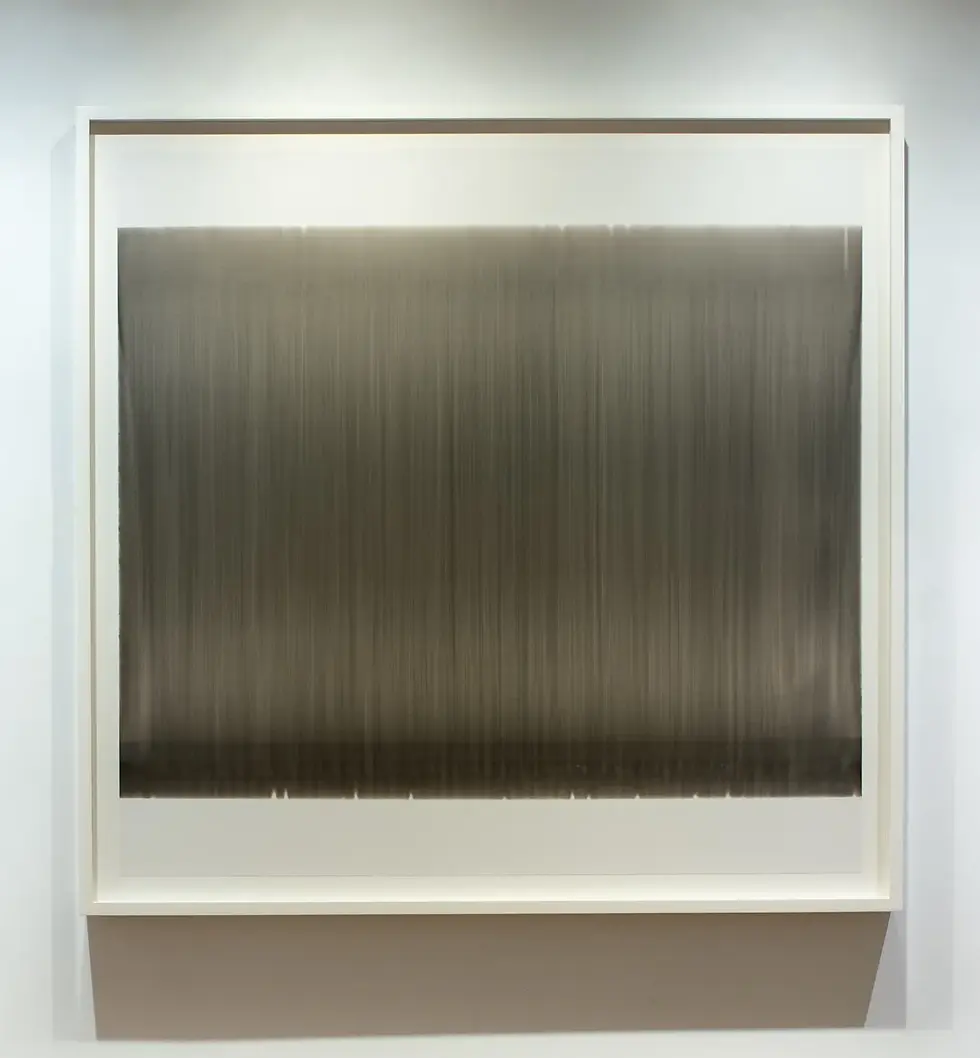

(1) Alison Rossiter, Ray Metzker's Agfa Brovira, 1970S (#4), 2020, Gelatin Silver Print, Framed: 53 7/8” x 55” (136.5 x 139.5 cm)
(2) “Defender Argo, expired September 1911, processed 2014”, (#6), 2014, unique silver gelatin print, 12.70 x 17.78 cm © Alison Rossiter, Courtesy Yossi Milo Gallery, New York
TOURNIER: Unlike the digital image, which is instantaneous and infinitely reproducible, your work implies a specific temporality involving selection and physical handling. How do you feel this process redefines the value of the minimal or vernacular image today?
ROSSITER: Processing old, fragile papers requires time and patience. The fact that my finished prints consist of metallic silver deposited on paper continues to amaze me. A black-and-white photograph is, after all, a rendering of silver. The light-sensitive silver gelatino-bromide material is transformed into the final image through chemical development: it is a fascinating process. The longevity of these materials is evident in photographic collections around the world.
In much the same way, anonymous vernacular photographs made with silver gelatino-bromide are remarkable temporal records. They bear witness not only to the history of popular culture, but also to the economic success of the photographic industry from the late 19th century through the 20th century. I am familiar with important collections of vernacular photography held both in public institutions and in private collections.
TOURNIER: Do you view photographic paper as an industrial material? Does your interest in it imply a desire to produce an autonomous object?
ROSSITER: Although photographic papers are manufactured to precise industrial standards—both in terms of chemical formulas and the structure of the paper base—they remain living, reactive substances that require a person's intervention to be developed once they leave the factory. Every darkroom printer has a slightly different technique. The materials thus allow for the expression of an individual style. I consider silver gelatino-bromide papers to possess a vitality and capacity for activation that can persist for over a century. Empty packaging is merely a graphic vestige of an era; a package that still contains unused sheets of paper, however, is, so to speak, "alive."
TOURNIER: The Minimalists of the 1960s spoke of "Truth to Materials." How is this concept transformed for you in the virtual era?
ROSSITER: My own interpretation of "truth to materials" lies in bringing old photographic papers back to life so that they themselves become the subject of the work.
My use of industrially produced photographic papers may, to some extent, align with a principle of 1960s Minimalism. However, the papers I work with today are fragile, and the relationship I have with them is deeply personal.
These materials have undergone many alterations: temperature variations, humidity, physical damage, atmospheric pollution. My challenge is to produce carefully developed prints so that their unique histories can surface.
I strive to process each sheet as best I can in my chemical baths. I want to understand what these papers have been through. To my eyes, the resulting prints make time visible.
TOURNIER: Does the term "minimalism" still hold meaning for you in contemporary photography? How do you view the connection between your work and the dynamics of subjectivation associated with Minimal Art?
ROSSITER: The term "minimalism" in photography immediately brings to mind the work of Lewis Baltz, whose photographs of industrial landscapes from the 1970s were as radically austere as the Minimalist sculptures of the 1960s.
In the late 1990s, Marco Breuer used photographic papers and processes with the physical approach of a sculptor: he scratched, folded, sanded, punctured, or burned the paper's surface to produce photographic abstractions.
Regarding my work and Marco Breuer's, I prefer to use the words "minimal" or "minimalist" as descriptive adjectives—lowercase—rather than as historical references to Minimalism and Postminimalism.
I use the standardized paper formats produced by manufacturers as guides for assembling several prints together. These dimensions allow for the formation of geometric grids that can evoke certain Minimalist structures. I haven't given extensive thought to my direct relationship to the 1960s, but I appreciate the adjective "minimalist" to describe the simplicity of my work.
TOURNIER: Unlike the digital image, which is instantaneous and infinitely reproducible, your work implies a specific temporality involving selection and physical handling. How do you feel this process redefines the value of the minimal or vernacular image today?
ROSSITER: Processing old, fragile papers requires time and patience. The fact that my finished prints consist of metallic silver deposited on paper continues to amaze me. A black-and-white photograph is, after all, a rendering of silver. The light-sensitive silver gelatino-bromide material is transformed into the final image through chemical development: it is a fascinating process. The longevity of these materials is evident in photographic collections around the world.
In much the same way, anonymous vernacular photographs made with silver gelatino-bromide are remarkable temporal records. They bear witness not only to the history of popular culture, but also to the economic success of the photographic industry from the late 19th century through the 20th century. I am familiar with important collections of vernacular photography held both in public institutions and in private collections.
TOURNIER: Do you view photographic paper as an industrial material? Does your interest in it imply a desire to produce an autonomous object?
ROSSITER: Although photographic papers are manufactured to precise industrial standards—both in terms of chemical formulas and the structure of the paper base—they remain living, reactive substances that require a person's intervention to be developed once they leave the factory. Every darkroom printer has a slightly different technique. The materials thus allow for the expression of an individual style. I consider silver gelatino-bromide papers to possess a vitality and capacity for activation that can persist for over a century. Empty packaging is merely a graphic vestige of an era; a package that still contains unused sheets of paper, however, is, so to speak, "alive."
TOURNIER: The Minimalists of the 1960s spoke of "Truth to Materials." How is this concept transformed for you in the virtual era?
ROSSITER: My own interpretation of "truth to materials" lies in bringing old photographic papers back to life so that they themselves become the subject of the work.
My use of industrially produced photographic papers may, to some extent, align with a principle of 1960s Minimalism. However, the papers I work with today are fragile, and the relationship I have with them is deeply personal.
These materials have undergone many alterations: temperature variations, humidity, physical damage, atmospheric pollution. My challenge is to produce carefully developed prints so that their unique histories can surface.
I strive to process each sheet as best I can in my chemical baths. I want to understand what these papers have been through. To my eyes, the resulting prints make time visible.
TOURNIER: Does the term "minimalism" still hold meaning for you in contemporary photography? How do you view the connection between your work and the dynamics of subjectivation associated with Minimal Art?
ROSSITER: The term "minimalism" in photography immediately brings to mind the work of Lewis Baltz, whose photographs of industrial landscapes from the 1970s were as radically austere as the Minimalist sculptures of the 1960s.
In the late 1990s, Marco Breuer used photographic papers and processes with the physical approach of a sculptor: he scratched, folded, sanded, punctured, or burned the paper's surface to produce photographic abstractions.
Regarding my work and Marco Breuer's, I prefer to use the words "minimal" or "minimalist" as descriptive adjectives—lowercase—rather than as historical references to Minimalism and Postminimalism.
I use the standardized paper formats produced by manufacturers as guides for assembling several prints together. These dimensions allow for the formation of geometric grids that can evoke certain Minimalist structures. I haven't given extensive thought to my direct relationship to the 1960s, but I appreciate the adjective "minimalist" to describe the simplicity of my work.
© DORIAN LAFARGUE


