

ALIX
BOILLOT
INTERVIEW
2026-01-26
Nour Tournier
Nour Tournier
© DORIAN LAFARGUE
(1) ADIEU BEAUTÉ, Since 2021, Photography, 33.75 x 60 cm © Alix Boillot
(2) ROCKY II, 2021, Dermograph tattoo, Dimensions variable © Alix Boillot
© DORIAN LAFARGUE
(1) GIRAVOLTE, 2025, Copper, zinc, aluminum, tin, cupronickel, nickel silver, nickel; diameter 30 cm © Alix Boillot
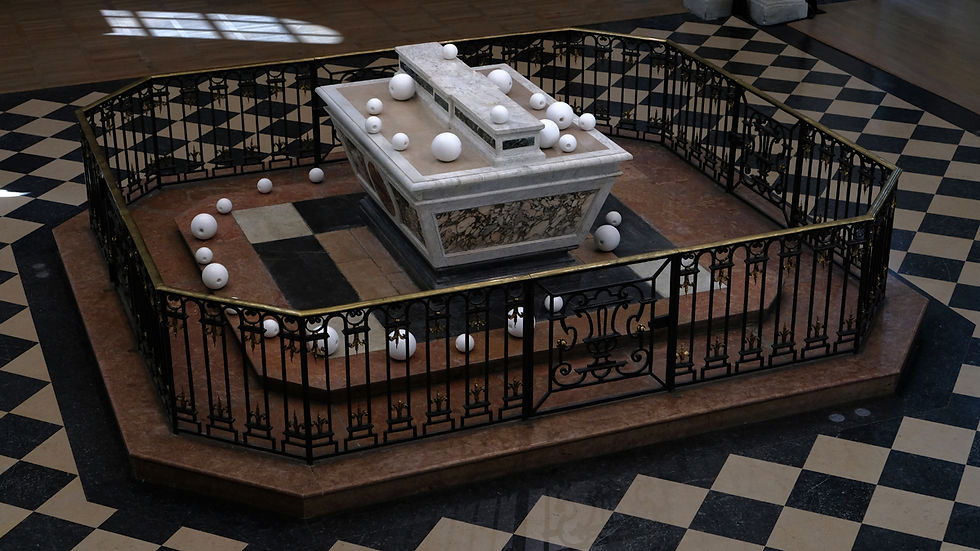
(2) L'ÉTERNITÉ (2), 2024, Sodium chloride (salt), dimensions variable © Alix Boillot
© DORIAN LAFARGUE
ALIX
BOILLOT
INTERVIEW
2026-01-26
Nour Tournier
What are our rituals, our tears, and our mystical attachments truly worth? Trained at the École des Arts Décoratifs before taking up residencies at the Villa Medici and the Fondation Fiminco, Alix Boillot subtly interrogates the nature of value. Drawing from her background as a scenographer, she infuses her sculptures with a distinct vitality: ephemeral works destined for their own erasure, positioning lived experience as a vital form of resistance. Interview.



(1) ADIEU BEAUTÉ, Since 2021, Photography, 33.75 x 60 cm © Alix Boillot
(2) ROCKY II, 2021, Dermograph tattoo, Dimensions variable © Alix Boillot
NOUR TOURNIER: Do you consider your work to be minimal?
ALIX BOILLOT: Minimal, no. I speak more of reduction or distillation than minimalism, as the latter carries a whole history of art to which I don’t feel heir. Conceptual, yes, in the sense that gestures are what have left the deepest mark on me. Yet I distance myself from conceptual art by assigning value to material and technique, which are often treated as minor concerns within it. My background is in the performing arts and live performance. In theater, dramaturgy is central: it teaches us that on stage, everything signifies. That trajectory led me naturally toward the conceptual on the one hand, and toward radical distillation on the other.
TOURNIER: What is your first "physical" memory of minimal art?
BOILLOT: I remember studying White on White in school. I was fascinated, especially by the fact that such an approach could be subsumed under what we call art. Later, I frequented the Fondation Maeght—which is more oriented toward modern art—and the MAMAC in Nice, which was filled with works by Yves Klein and stripped-back forms. That was deeply foundational. By contrast, the recent exhibition at the Bourse de Commerce didn’t particularly move me.
TOURNIER: What were the pivotal encounters and influences during your training?
BOILLOT: Yves Klein was essential because of the primacy he assigned to the gesture over the final object. That is precisely what interests me. Pierre Huyghe’s exhibition at the Centre Pompidou was also a turning point. I was graduating from Arts Déco in 2015, torn between the visual arts and live performance. Walking through that exhibition, I realized there was no need to choose—something was already weaving itself together across all the works. As for theater, like many people, high school trips had bored me. I entered Arts Déco for the books, then gravitated toward scenography out of a desire for collective practice. It was our instructors who took us to the Festival d’Automne; thanks to them, I discovered artists like Jérôme Bel and Xavier Le Roy, whose protocol-based rigor—rendered complex by a temporal thread that remains very present in my practice—left a profound mark on me.
TOURNIER: Your work frequently utilizes found materials. Is this manipulation a stance of resistance against contemporary pressures of productivity?
BOILLOT: My bedside book is The Uncontrollability of the World by Hartmut Rosa; I’ve read it time and again. In the performing and visual arts, some order materials on platforms like Amazon, while others prefer to scavenge salvaged materials—which takes much more time. There is something of the unavailable in the act of finding. It requires a gesture, a certain humility that is dear to me. I refuse to design a piece in three clicks. It’s a bit like the snow in Goodbye Beauty: the duty of waiting for the snow calms the productivist impulse. The gesture, in all its patience, is fundamental to my practice.
ALIX BOILLOTINTERVIEW


TOURNIER: What were the pivotal encounters and influences during your training?
BOILLOT: Yves Klein was essential because of the primacy he assigned to the gesture over the final object. That is precisely what interests me. Pierre Huyghe’s exhibition at the Centre Pompidou was also a turning point. I was graduating from Arts Déco in 2015, torn between the visual arts and live performance. Walking through that exhibition, I realized there was no need to choose—something was already weaving itself together across all the works. As for theater, like many people, high school trips had bored me. I entered Arts Déco for the books, then gravitated toward scenography out of a desire for collective practice. It was our instructors who took us to the Festival d’Automne; thanks to them, I discovered artists like Jérôme Bel and Xavier Le Roy, whose protocol-based rigor—rendered complex by a temporal thread that remains very present in my practice—left a profound mark on me.
TOURNIER: Your work frequently utilizes found materials. Is this manipulation a stance of resistance against contemporary pressures of productivity?
BOILLOT: My bedside book is The Uncontrollability of the World by Hartmut Rosa; I’ve read it time and again. In the performing and visual arts, some order materials on platforms like Amazon, while others prefer to scavenge salvaged materials—which takes much more time. There is something of the unavailable in the act of finding. It requires a gesture, a certain humility that is dear to me. I refuse to design a piece in three clicks. It’s a bit like the snow in Goodbye Beauty: the duty of waiting for the snow calms the productivist impulse. The gesture, in all its patience, is fundamental to my practice.
TOURNIER: What were the pivotal encounters and influences during your training?
BOILLOT: Yves Klein was essential because of the primacy he assigned to the gesture over the final object. That is precisely what interests me. Pierre Huyghe’s exhibition at the Centre Pompidou was also a turning point. I was graduating from Arts Déco in 2015, torn between the visual arts and live performance. Walking through that exhibition, I realized there was no need to choose—something was already weaving itself together across all the works. As for theater, like many people, high school trips had bored me. I entered Arts Déco for the books, then gravitated toward scenography out of a desire for collective practice. It was our instructors who took us to the Festival d’Automne; thanks to them, I discovered artists like Jérôme Bel and Xavier Le Roy, whose protocol-based rigor—rendered complex by a temporal thread that remains very present in my practice—left a profound mark on me.
TOURNIER: Your work frequently utilizes found materials. Is this manipulation a stance of resistance against contemporary pressures of productivity?
BOILLOT: My bedside book is The Uncontrollability of the World by Hartmut Rosa; I’ve read it time and again. In the performing and visual arts, some order materials on platforms like Amazon, while others prefer to scavenge salvaged materials—which takes much more time. There is something of the unavailable in the act of finding. It requires a gesture, a certain humility that is dear to me. I refuse to design a piece in three clicks. It’s a bit like the snow in Goodbye Beauty: the duty of waiting for the snow calms the productivist impulse. The gesture, in all its patience, is fundamental to my practice.
(1) ADIEU BEAUTÉ, Since 2021, Photography, 33.75 x 60 cm © Alix Boillot
(2) ROCKY II, 2021, Dermograph tattoo, Dimensions variable © Alix Boillot
TOURNIER: You regularly work with the ephemeral (snow, ice, performance, protocols). Is this a way to bypass the art market?
BOILLOT: My roots in the performing arts have a lot to do with it. They carry a permanent questioning of the notion of ownership. The dynamic is the same in theater as in a museum: the viewer pays for admission, contemplates the work, and leaves empty-handed. Yet what was experienced retains an incalculable value—a moment was shared. My work inherits that logic. Selling is not my priority. Take Rocky II, for instance: it’s a tattoo. To own the work, you have to get it tattooed onto your skin. That displaces the entire question of material ownership.
TOURNIER: The sphere recurs throughout your pieces (Giravolte, L’Éternité...). Why this form rather than more cubic geometries?
BOILLOT: The sphere asserted itself while I was preparing for the Lyon Biennale. I was working on tears, which led me to pearls. Pliny the Elder wrote that oyster pearls were once thought to form from dew... Everything connected. The pearl was one of the earliest currencies; it embodies both intrinsic and extrinsic value, much like an inherited necklace. For Giravolte, finding the right form was difficult, as ex-votos are often figurative. The sphere surfaced early in the process, then reappeared a year later. That time, it asserted itself through its potentiality: at different scales, it can evoke an orange, a cell, or a planet. Since my ex-voto was collective, that open potentiality felt right.
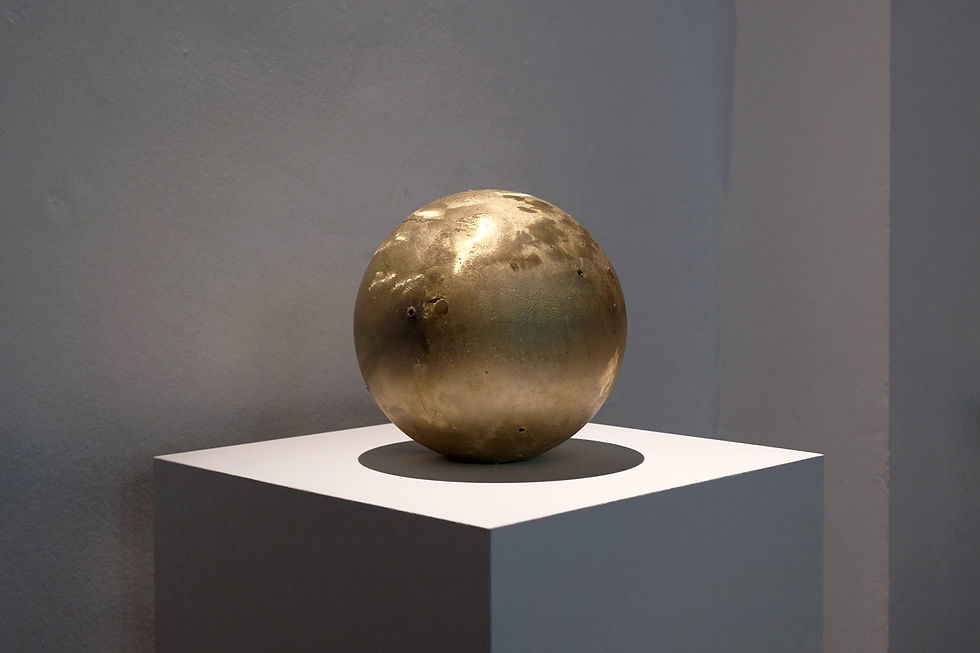
(1) GIRAVOLTE, 2025, Copper, zinc, aluminum, tin, cupronickel, nickel silver, nickel; diameter 30 cm © Alix Boillot
(2) L'ÉTERNITÉ (2), 2024, Sodium chloride (salt), dimensions variable © Alix Boillot
TOURNIER: Your work touches on ritual, myth, and the sacred. How does formal economy serve these subjects?
BOILLOT: What interests me is the symbolic charge held within an object. Formal reduction simply magnifies that aura. Figuration tends to trap the gaze within what it depicts. A minimal form like the sphere demands heightened attention; it invites you to read the gallery text, to look beyond surface appearances. Rendering narratives abstract also renders them timeless, whereas figuration often anchors them to a specific era. The imagination deploys itself far more powerfully in contact with abstraction.
TOURNIER: What is your relationship to politics in art?
BOILLOT: The condition of being an artist has become so precarious that simply remaining one is a political act. It’s a form of resistance. During my residency at Fiminco, I caught myself slipping into a production logic oriented toward sales. Ultimately, I made a choice: I prefer precariousness to compromise. Art is profoundly unproductive, and that is precisely what makes it essential. Today, a capitalist environment demands that we abandon whatever isn't immediately useful or profitable. Yet nothing is more beautiful than the useless and the unproductive. During the pandemic, we were bombarded with the imperative of "resilience"—this obligation to press on at all costs. But no: we have the right to collapse and to cry. Devoting time to a woman who is crying is a political act.
TOURNIER: Your work touches on ritual, myth, and the sacred. How does formal economy serve these subjects?
BOILLOT: What interests me is the symbolic charge held within an object. Formal reduction simply magnifies that aura. Figuration tends to trap the gaze within what it depicts. A minimal form like the sphere demands heightened attention; it invites you to read the gallery text, to look beyond surface appearances. Rendering narratives abstract also renders them timeless, whereas figuration often anchors them to a specific era. The imagination deploys itself far more powerfully in contact with abstraction.
TOURNIER: What is your relationship to politics in art?
BOILLOT: The condition of being an artist has become so precarious that simply remaining one is a political act. It’s a form of resistance. During my residency at Fiminco, I caught myself slipping into a production logic oriented toward sales. Ultimately, I made a choice: I prefer precariousness to compromise. Art is profoundly unproductive, and that is precisely what makes it essential. Today, a capitalist environment demands that we abandon whatever isn't immediately useful or profitable. Yet nothing is more beautiful than the useless and the unproductive. During the pandemic, we were bombarded with the imperative of "resilience"—this obligation to press on at all costs. But no: we have the right to collapse and to cry. Devoting time to a woman who is crying is a political act.
© DORIAN LAFARGUE


