

ANNA
ATKINS
CYANOTYPES
2026-03-23
Grace Amados
Grace Amados
© DORIAN LAFARGUE
(1) Cystoseira fibrosa
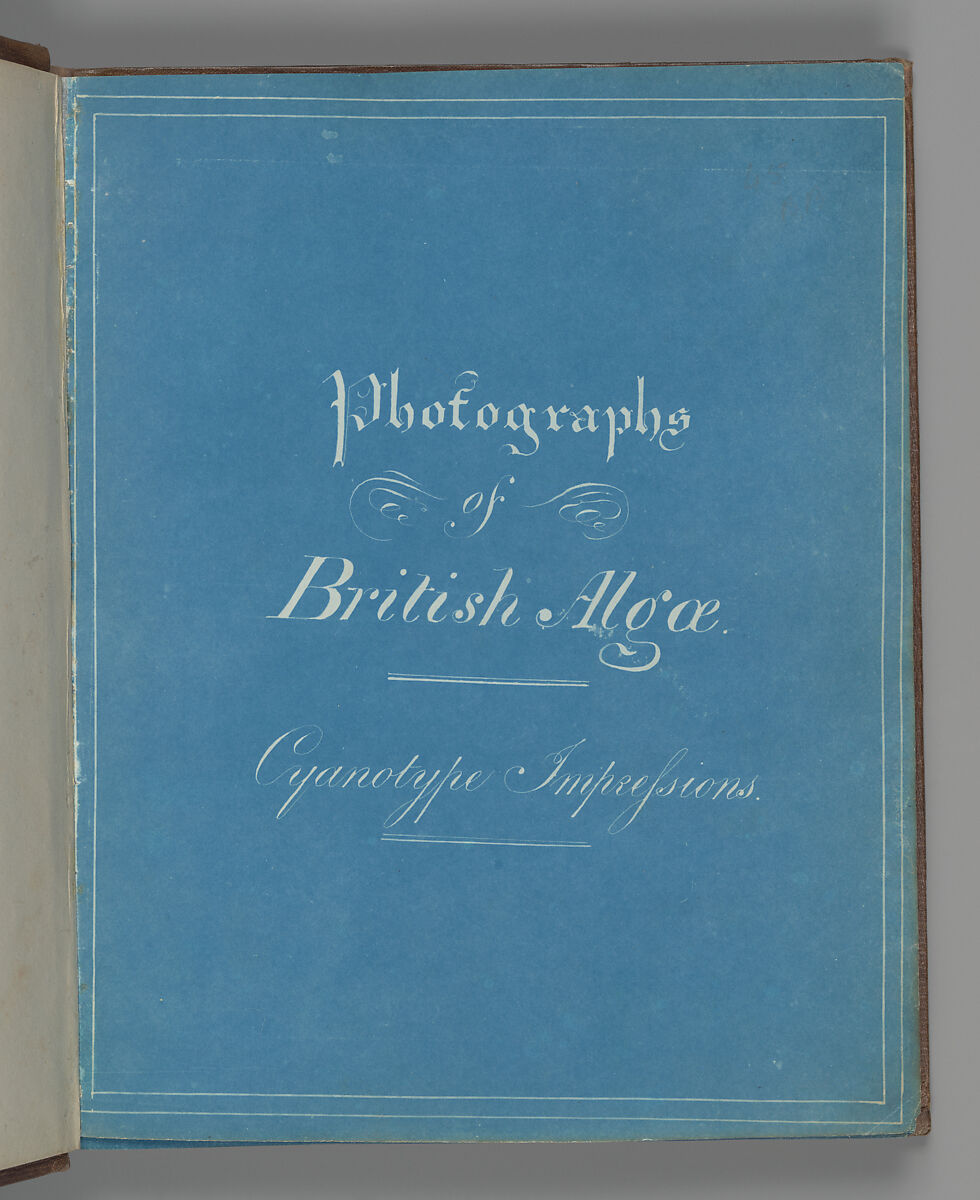
(2) Photographs of British Algae: Cyanotype Impressions, Anna Atkins (British, 1799–1871), 1843–53, Cyanotypes © Gilman Collection, Purchase, The Horace W. Goldsmith Foundation Gift, through Joyce and Robert Menschel, 2005
© DORIAN LAFARGUE
(1) Laminaria folium
(2) Portrait of Anna Atkins, albumen print, 1861
© DORIAN LAFARGUE
ANNA
ATKINS
CYANOTYPES
2026-03-23
Grace Amados
Long before plants became a fully fledged aesthetic motif, Anna Atkins observed them, classified them, and brought them into the image in a new way. With her cyanotypes of algae and plants—published as early as 1843 in Photographs of British Algae: Cyanotype Impressions—the English botanist invented a unique form at the crossroads of scientific observation and image-making.

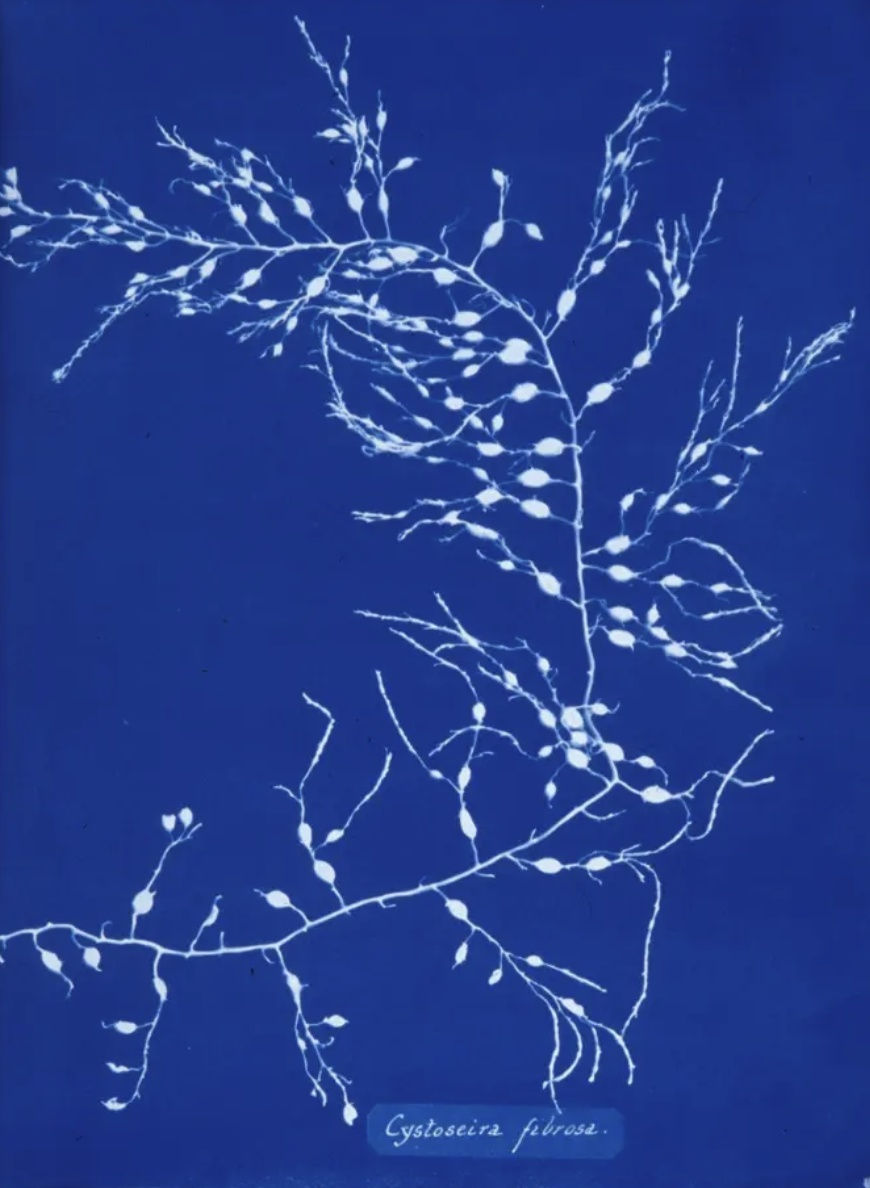
(1) Cystoseira fibrosa
(2) Photographs of British Algae: Cyanotype Impressions, Anna Atkins (British, 1799–1871), 1843–53, Cyanotypes © Gilman Collection, Purchase, The Horace W. Goldsmith Foundation Gift, through Joyce and Robert Menschel, 2005
A Woman of Science in a Men’s World
Anna Atkins, born in 1799, was the daughter of John George Children, a renowned chemist, mineralogist, and zoologist. As a result, she enjoyed an education that was rare for a woman of her time.
From an early age, she learned to observe, draw, and name. She grew up in a cultured and privileged environment at the heart of an England where the sciences were becoming structured and institutionalized, yet remained largely dominated by men.
At the time, botany was one of the few scientific fields accessible to women of high society. Far from being a space of equality, of course, botany was a tolerated territory—a place where one could collect, classify, illustrate, and press plants. Atkins found a field of study there, but she also set out to develop a method. She did not truly view plants as something decorative, but rather saw in them a genuine discipline to be observed.
Indeed, before being regarded as an artist, Anna Atkins was first and foremost an observer. Her plant collection and classification work relied on precision and patience. Yet this rigor did not produce cold images; on the contrary, it revealed all the delicacy of plant forms.
Cyanotype, or the Direct Impression of Reality
What pushed Anna Atkins' work into the history of image-making was the cyanotype. Developed in the early 1840s, this process produces blue images through direct contact.
In practice, the process involves placing a plant (algae, fern, flowers, plants) onto paper treated with two chemical solutions, and then exposing it to light. After rinsing, the image appears in white against a Prussian blue or cyan blue background. The image is thus born from a physical encounter between the living object and its recording surface. Atkins' cyanotypes are not representations in the classical sense: they are impressions. The plant is not interpreted by a artist's hand; it leaves its trace directly. There is an almost uncanny form of truth to this. In doing so, Atkins minimizes the distance between the object observed and its reproduction.
Yet this accuracy is far from cold or austere, because the cyanotype also transforms reality. Algae become silhouettes or organic constellations. Their branches stand out like drawings against the blue background. This is the true power of the process: capturing scientific detail while opening up a space for abstraction. With Atkins, accuracy does not diminish poetry; it becomes its very foundation.
ANNA ATKINS CYANOTYPES


Cyanotype, or the Direct Impression of Reality
What pushed Anna Atkins' work into the history of image-making was the cyanotype. Developed in the early 1840s, this process produces blue images through direct contact.
In practice, the process involves placing a plant (algae, fern, flowers, plants) onto paper treated with two chemical solutions, and then exposing it to light. After rinsing, the image appears in white against a Prussian blue or cyan blue background. The image is thus born from a physical encounter between the living object and its recording surface. Atkins' cyanotypes are not representations in the classical sense: they are impressions. The plant is not interpreted by a artist's hand; it leaves its trace directly. There is an almost uncanny form of truth to this. In doing so, Atkins minimizes the distance between the object observed and its reproduction.
Yet this accuracy is far from cold or austere, because the cyanotype also transforms reality. Algae become silhouettes or organic constellations. Their branches stand out like drawings against the blue background. This is the true power of the process: capturing scientific detail while opening up a space for abstraction. With Atkins, accuracy does not diminish poetry; it becomes its very foundation.
Cyanotype, or the Direct Impression of Reality
What pushed Anna Atkins' work into the history of image-making was the cyanotype. Developed in the early 1840s, this process produces blue images through direct contact.
In practice, the process involves placing a plant (algae, fern, flowers, plants) onto paper treated with two chemical solutions, and then exposing it to light. After rinsing, the image appears in white against a Prussian blue or cyan blue background. The image is thus born from a physical encounter between the living object and its recording surface. Atkins' cyanotypes are not representations in the classical sense: they are impressions. The plant is not interpreted by a artist's hand; it leaves its trace directly. There is an almost uncanny form of truth to this. In doing so, Atkins minimizes the distance between the object observed and its reproduction.
Yet this accuracy is far from cold or austere, because the cyanotype also transforms reality. Algae become silhouettes or organic constellations. Their branches stand out like drawings against the blue background. This is the true power of the process: capturing scientific detail while opening up a space for abstraction. With Atkins, accuracy does not diminish poetry; it becomes its very foundation.
(1) Cystoseira fibrosa
(2) Photographs of British Algae: Cyanotype Impressions, Anna Atkins (British, 1799–1871), 1843–53, Cyanotypes © Gilman Collection, Purchase, The Horace W. Goldsmith Foundation Gift, through Joyce and Robert Menschel, 2005
From the Cyanotype to the Photographic Book of Life
For Anna Atkins, cyanotypes do not only make sense individually: they belong to a larger whole—that of plates and albums—where the book becomes a tool for organizing, transmitting, and circulating botanical knowledge. Photographs of British Algae: Cyanotype Impressions is therefore not merely a collection of images, but a photographic herbarium bound into a book, widely considered today to be one of the very first photographic books.
This effort to classify is by no means rigid, however. The compositions are carefully crafted, with each piece of algae arranged with extreme attention, almost staged on the page. Scientific precision is never at odds with formal beauty: it operates through it.
Thanks to the cyanotype, Atkins was able to produce multiple impressions of living specimens while preserving the hand-crafted nature of their creation. Prepared and assembled by hand, each copy demonstrates that in its early days, photographic reproducibility was less about standardization and more about a slow, material practice where the multiple remained singular.


(1) Laminaria folium
(2) Portrait of Anna Atkins, albumen print, 1861
Why Her Work Still Speaks to Us Today
If Anna Atkins is so frequently rediscovered today, it is not only because of her importance as a pioneer, but because her work still resonates with very contemporary concerns: our relationship to living things, to archives, to slow techniques, and to the materiality of images. In an era of digital flows and infinite reproduction, her cyanotypes remind us that an image can still be the product of time, gesture, and physical contact.
The cyanotype carries within it something that our time is seeking once again: a visible, almost humble process of creation, where beauty stems less from special effects than from careful attention. In Atkins’ work, the plant is never a decorative motif in any weak sense; it is a subject, almost a presence.
Perhaps it is here that the lasting power of her work lies. Anna Atkins shows that one can look at a plant with the tools of science while still preserving its sense of wonder and mystery.
Sources:
WALTHER, Peter, Anna Atkins. Cyanotypes, Cologne, Taschen, 2023.
GALIFOT, Thomas, "Anna Atkins", AWARE. Archives of Women Artists, Research and Exhibitions.
"Anna Atkins, pionnière méconnue du cyanotype célébrée dans un beau livre", Beaux Arts Magazine, 2023.
Why Her Work Still Speaks to Us Today
If Anna Atkins is so frequently rediscovered today, it is not only because of her importance as a pioneer, but because her work still resonates with very contemporary concerns: our relationship to living things, to archives, to slow techniques, and to the materiality of images. In an era of digital flows and infinite reproduction, her cyanotypes remind us that an image can still be the product of time, gesture, and physical contact.
The cyanotype carries within it something that our time is seeking once again: a visible, almost humble process of creation, where beauty stems less from special effects than from careful attention. In Atkins’ work, the plant is never a decorative motif in any weak sense; it is a subject, almost a presence.
Perhaps it is here that the lasting power of her work lies. Anna Atkins shows that one can look at a plant with the tools of science while still preserving its sense of wonder and mystery.
Sources:
WALTHER, Peter, Anna Atkins. Cyanotypes, Cologne, Taschen, 2023.
GALIFOT, Thomas, "Anna Atkins", AWARE. Archives of Women Artists, Research and Exhibitions.
"Anna Atkins, pionnière méconnue du cyanotype célébrée dans un beau livre", Beaux Arts Magazine, 2023.
© DORIAN LAFARGUE


