

MAREN
HASSINGER
INTERVIEW
2026-01-22
Nour Tournier
Nour Tournier
© DORIAN LAFARGUE
(1) Maren Hassinger, River, 1972/2011, Mixed-media installation with steel chains and rope, 17.8 × 226.1 × 909.3 cm © The Studio Museum in Harlem
(2) Maren Hassinger, On Dangerous Ground (l’artiste dans son atelier), avril 1981, © Photo : Museum Associates/LACMA, avec l’aimable autorisation de la galerie Susan Inglett, New York
© DORIAN LAFARGUE
(1) “Birthright” (still) by Maren Hassinger, 2005. Single-channel video (color, sound), 12:12 mins. Edition of 5 plus 2 artist’s proofs. Courtesy of Susan Inglett Gallery, NYC
(2) Installation view: Maren Hassinger, Nature, Sweet Nature, Aspen Art Museum, 2020. Photo: Simon Klein
© DORIAN LAFARGUE
MAREN
HASSINGER
INTERVIEW
2026-01-22
Nour Tournier
Breaking away from the late modernisms of her contemporaries, Maren Hassinger’s approach breathes an organic dimension into industrial components. On the occasion of an intimate conversation in January 2026, the artist reflects on the pivotal bifurcations of her education, the fortuitous discovery of her signature medium, and the transmission of a sculptural lineage that continues to defy time.



(1) Maren Hassinger, River, 1972/2011, Mixed-media installation with steel chains and rope, 17.8 × 226.1 × 909.3 cm © The Studio Museum in Harlem
(2) Maren Hassinger, On Dangerous Ground (l’artiste dans son atelier), avril 1981, © Photo : Museum Associates/LACMA, avec l’aimable autorisation de la galerie Susan Inglett, New York
Her totemic installations of galvanized wire rope, which evoke arboreal landscapes suspended between resilience and erasure, recall her practice’s elective affinities with Arte Povera or the material philosophies of the Japanese Mono-ha group. Indissociable from collective dynamics and an early eco-feminist engagement, this pioneer’s oeuvre places empathy and environmental consciousness at the very center of the aesthetic experience.
NOUR TOURNIER: You began your artistic training in dance before transitioning to sculpture. How did you pivot from that initial relationship with the body to working with volume?
MAREN HASSINGER: I cannot tell you how devastated I was to find out that I couldn’t major in dance at college. I think I wept over it. Once I finally got over it, I began to find pleasure in studying fine art and making sculptures. My sculpture professor, Isaac Witkin, was incredibly encouraging and supportive. The total confidence I had in his critiques—which owed much to his exceptional training in London—nurtured me in this initially unwanted practice. I eventually accepted that I couldn’t have done better elsewhere, and that it would lead me toward a career I had never envisioned.
Forced to abandon dance for sculpture at Bennington College in 1965, Hassinger subsequently entered the fiber arts department at UCLA in 1970, where she forged a practice resistant to exploitative industrial logics.
TOURNIER: When you first began your studies, which artists shaped your interest in sculpture?
HASSINGER: I remember having a painter friend with whom I went to class. He was deeply invested in the ideas and techniques of Kenneth Noland. Personally, I don’t recall having similar inspirations. I remember reading extensively and going to museums to look at David Smith's work, but he belonged to a much older generation; I believe he passed away just as I began looking at his art. Among my contemporaries, Isaac Witkin was my greatest inspiration.
TOURNIER: Within the context of UCLA in the 1970s, how did you come to assert your creative voice and claim your preferred materials?
HASSINGER: I think my student work generally aligned with what was happening in Los Angeles at the time. The issue was that when I went to UCLA, I couldn’t get into the classes I actually wanted to take. The sculpture department was particularly insular, and the students didn’t want outsiders enrolling in their courses. Consequently, I found myself in a fiber arts class, and that is where I learned everything. One day, while hunting for materials, I visited a yard and found these wire ropes sitting right in the middle of the ground. I examined them from every angle, and something clicked. I realized this material had the potential to yield something genuinely different. Following that encounter, I found places where I could purchase it commercially and began using it explicitly.
MAREN HASSINGER INTERVIEW


Forced to abandon dance for sculpture at Bennington College in 1965, Hassinger subsequently entered the fiber arts department at UCLA in 1970, where she forged a practice resistant to exploitative industrial logics.
TOURNIER: When you first began your studies, which artists shaped your interest in sculpture?
HASSINGER: I remember having a painter friend with whom I went to class. He was deeply invested in the ideas and techniques of Kenneth Noland. Personally, I don’t recall having similar inspirations. I remember reading extensively and going to museums to look at David Smith's work, but he belonged to a much older generation; I believe he passed away just as I began looking at his art. Among my contemporaries, Isaac Witkin was my greatest inspiration.
TOURNIER: Within the context of UCLA in the 1970s, how did you come to assert your creative voice and claim your preferred materials?
HASSINGER: I think my student work generally aligned with what was happening in Los Angeles at the time. The issue was that when I went to UCLA, I couldn’t get into the classes I actually wanted to take. The sculpture department was particularly insular, and the students didn’t want outsiders enrolling in their courses. Consequently, I found myself in a fiber arts class, and that is where I learned everything. One day, while hunting for materials, I visited a yard and found these wire ropes sitting right in the middle of the ground. I examined them from every angle, and something clicked. I realized this material had the potential to yield something genuinely different. Following that encounter, I found places where I could purchase it commercially and began using it explicitly.
Forced to abandon dance for sculpture at Bennington College in 1965, Hassinger subsequently entered the fiber arts department at UCLA in 1970, where she forged a practice resistant to exploitative industrial logics.
TOURNIER: When you first began your studies, which artists shaped your interest in sculpture?
HASSINGER: I remember having a painter friend with whom I went to class. He was deeply invested in the ideas and techniques of Kenneth Noland. Personally, I don’t recall having similar inspirations. I remember reading extensively and going to museums to look at David Smith's work, but he belonged to a much older generation; I believe he passed away just as I began looking at his art. Among my contemporaries, Isaac Witkin was my greatest inspiration.
TOURNIER: Within the context of UCLA in the 1970s, how did you come to assert your creative voice and claim your preferred materials?
HASSINGER: I think my student work generally aligned with what was happening in Los Angeles at the time. The issue was that when I went to UCLA, I couldn’t get into the classes I actually wanted to take. The sculpture department was particularly insular, and the students didn’t want outsiders enrolling in their courses. Consequently, I found myself in a fiber arts class, and that is where I learned everything. One day, while hunting for materials, I visited a yard and found these wire ropes sitting right in the middle of the ground. I examined them from every angle, and something clicked. I realized this material had the potential to yield something genuinely different. Following that encounter, I found places where I could purchase it commercially and began using it explicitly.
(1) Maren Hassinger, River, 1972/2011, Mixed-media installation with steel chains and rope, 17.8 × 226.1 × 909.3 cm © The Studio Museum in Harlem
(2) Maren Hassinger, On Dangerous Ground (l’artiste dans son atelier), avril 1981, © Photo : Museum Associates/LACMA, avec l’aimable autorisation de la galerie Susan Inglett, New York
TOURNIER: How did you navigate that transition from fiber to wire rope? What drew you to such a radically different material?
HASSINGER: I eventually grew weary of textiles; I found them too pliable, and therefore not sculptural enough. So when I encountered wire rope, I was thrilled to find an alternative: it behaves like a fiber because it is twisted around a core, but because it is steel, the result remains rigid without sagging. It possesses more stamina, which allowed me to build out surfaces. I wanted to retain that tactile engagement with the material, that sculptural surface.
By twisting, bending, and fraying metal threads, Hassinger’s forms simultaneously evoke the taut limbs of dancers and the silhouettes of trees. In an audio recording produced for the Museum of Modern Art, New York, she describes the material as being "like a flowing river, a branch in the wind, leaves, twigs... and yet, it's steel." Here, her nine-meter-long piece River (1972)—one of her earliest works—proves particularly revelatory.
This desire to intimately bind corporeal movement to matter assumed a collective dimension during the 1970s, when she became an active participant in the performances of her Los Angeles peers associated with Studio Z. Alongside Senga Nengudi and David Hammons, Hassinger developed a performance practice indissociable from her sculptures. A sense of longing and loss permeates actions such as Tree Duet I and II (1977), in which her body maneuvers in echo with a branch intertwined with cables, visually merging industrial steel fibers with natural twigs. It is precisely within this referenced natural world that she finds her inspiration, while also introducing natural materials into built environments, as seen in The Dream (2001) or Blanket of Branches (1986/2015).
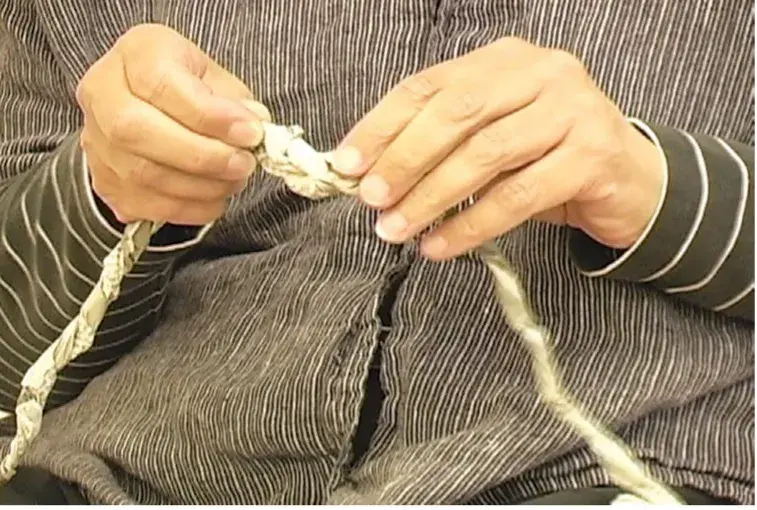

(1) “Birthright” (still) by Maren Hassinger, 2005. Single-channel video (color, sound), 12:12 mins. Edition of 5 plus 2 artist’s proofs. Courtesy of Susan Inglett Gallery, NYC
(2) Installation view: Maren Hassinger, Nature, Sweet Nature, Aspen Art Museum, 2020. Photo: Simon Klein
TOURNIER: Your practice is regularly framed in relation to environmental issues. How do you observe these concerns within your own creation?
HASSINGER: I think I have always been anxious about the natural world. It has always been an inspiration to me. By deploying materials that are fundamentally unnatural, I replicate ideas of nature. Right outside my window, there are pieces of wire rope embedded in a concrete base. The angle at which they are positioned evokes the caress of the blowing wind. That is how—even though nothing in the composition is natural—the idea of nature endures through the relational interplay of each element.
In 1981, she contributed to the landmark thirteenth issue of the journal Heresies, titled "Cultural Ecology." Conceived by Michelle Stuart and Joyce Kozloff, this historic issue theorized the intersection of the feminist revolution and the environmental movement. Hassinger presented Forest (1980), an installation realized for Art on the Beach at Battery Park, where her wire trees interacted with the site's actual topography to articulate a "longing for a lost natural space." These steel-gray rods, imbued with a post-apocalyptic quality, mimicked the tilt of surrounding saplings, seeking a harmony that industrial technology—of which the cable is a pure byproduct—threatens with extinction.
Feminist criticism, championed notably by Lucy Lippard, redefined the contours of minimal abstraction in a similar vein. As early as 1966, with her exhibition Eccentric Abstraction, Lippard hesitated a sculptural sensibility where form, far from being a monolithic and authoritarian whole, presents itself as a "vacillating and vulnerable" fragment. This concept resonates deeply with Hassinger’s insistence on using consciously allusive materials that hover between organic expressiveness and pure materiality.
TOURNIER: With several decades of hindsight, do you consider yourself a minimalist?
HASSINGER: I consider myself a minimalist artist. I make very simple, recognizable, and often circular forms, as is the case with this piece, which is called Looks like the Wind. Whether other minimalists consider me as such is another matter.
TOURNIER: Do you think that Minimal art remains highly influential in art schools among students, perhaps more so in America than in France?
HASSINGER: Yes, because it is part of history; it is part of what allowed the contemporary to emerge. I am no longer entirely aware of what students discuss in art schools because I no longer teach. But I know that with time, there is more and more art, and there are more and more artists. To participate in the contemporary, students must understand the underlying concepts of art that will allow them to make their own contribution. Some artists endure for centuries. And some are here today, gone tomorrow.
We extend our deepest gratitude to Ms. Hassinger for taking the time to answer our questions, for the kindness she showed throughout our exchange, and for the way in which she evokes every facet of her enduring practice.
TOURNIER: Your practice is regularly framed in relation to environmental issues. How do you observe these concerns within your own creation?
HASSINGER: I think I have always been anxious about the natural world. It has always been an inspiration to me. By deploying materials that are fundamentally unnatural, I replicate ideas of nature. Right outside my window, there are pieces of wire rope embedded in a concrete base. The angle at which they are positioned evokes the caress of the blowing wind. That is how—even though nothing in the composition is natural—the idea of nature endures through the relational interplay of each element.
In 1981, she contributed to the landmark thirteenth issue of the journal Heresies, titled "Cultural Ecology." Conceived by Michelle Stuart and Joyce Kozloff, this historic issue theorized the intersection of the feminist revolution and the environmental movement. Hassinger presented Forest (1980), an installation realized for Art on the Beach at Battery Park, where her wire trees interacted with the site's actual topography to articulate a "longing for a lost natural space." These steel-gray rods, imbued with a post-apocalyptic quality, mimicked the tilt of surrounding saplings, seeking a harmony that industrial technology—of which the cable is a pure byproduct—threatens with extinction.
Feminist criticism, championed notably by Lucy Lippard, redefined the contours of minimal abstraction in a similar vein. As early as 1966, with her exhibition Eccentric Abstraction, Lippard hesitated a sculptural sensibility where form, far from being a monolithic and authoritarian whole, presents itself as a "vacillating and vulnerable" fragment. This concept resonates deeply with Hassinger’s insistence on using consciously allusive materials that hover between organic expressiveness and pure materiality.
TOURNIER: With several decades of hindsight, do you consider yourself a minimalist?
HASSINGER: I consider myself a minimalist artist. I make very simple, recognizable, and often circular forms, as is the case with this piece, which is called Looks like the Wind. Whether other minimalists consider me as such is another matter.
TOURNIER: Do you think that Minimal art remains highly influential in art schools among students, perhaps more so in America than in France?
HASSINGER: Yes, because it is part of history; it is part of what allowed the contemporary to emerge. I am no longer entirely aware of what students discuss in art schools because I no longer teach. But I know that with time, there is more and more art, and there are more and more artists. To participate in the contemporary, students must understand the underlying concepts of art that will allow them to make their own contribution. Some artists endure for centuries. And some are here today, gone tomorrow.
We extend our deepest gratitude to Ms. Hassinger for taking the time to answer our questions, for the kindness she showed throughout our exchange, and for the way in which she evokes every facet of her enduring practice.
© DORIAN LAFARGUE


