RASHEED
ARAEEN
INTERVIEW
2026-01-10
Nour Tournier
Nour Tournier
© DORIAN LAFARGUE
(1) Rasheed Araeen, the original 'First Structure' (1987), before it was destroyed
COURTESY OF GROSVENOR GALLERY AND THE ARTIST WITH PERMISSION FOR VARSITY
(2) Rasheed Araeen, Paki Bastard, 1977, still image. Courtesy of the artist and Grosvenor Gallery.
© DORIAN LAFARGUE
(1) The Other Story: Afro-Asian Artists in Post-War Britain, Hayward Gallery, 1989-1990, installation photograph. Digital image courtesy of Rasheed Araeen and Asia Art Archive.
(2) Rasheed Araeen, Zero to Infinity à la Tate Modern, 2023, dans le cadre d’UNIQLO Tate Play, Ph. © Tate (Lucy Green)
© DORIAN LAFARGUE
RASHEED
ARAEEN
INTERVIEW
2026-01-10
Nour Tournier
Rasheed Araeen (born 1935 in Karachi, Pakistan) is an artist, activist, writer, publisher, and curator. In 1964, he moved to the United Kingdom after graduating with a degree in civil engineering. A seminal yet long-overlooked figure of the British avant-garde, he is recognized as a pioneer of minimalist sculpture in the region during the 1960s. From the founding of the legendary journal Third Text to the incendiary performances of the 1970s, his work is infused with political urgency and the necessity of postcolonial subjectivities, without ever relinquishing structural rigor. This interview, conducted on January 10, 2026, explores the emergence of a geometric abstraction developed as early as 1965 outside the North American canon, from which Western institutions sidelined the artist for decades. This testimonial argues for a deinstitutionalization of art, replacing a purely formal dialogue with historical minimalism in favor of a humanistic and "eco-aesthetic" vision of structure.

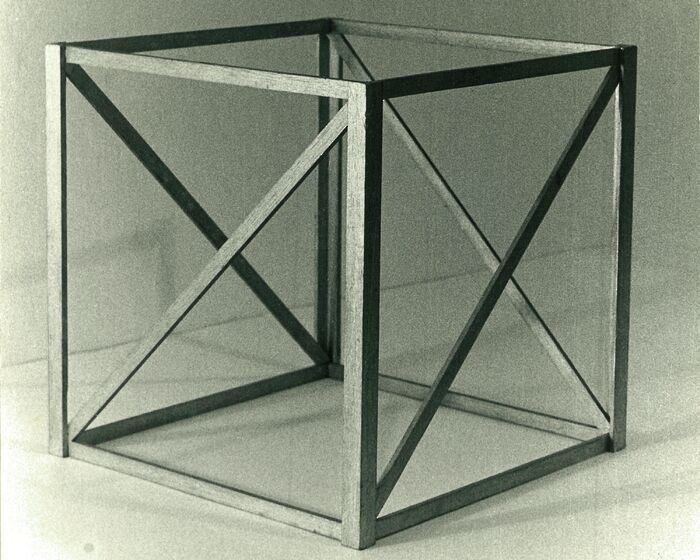
(1) Rasheed Araeen, the original 'First Structure' (1987), before it was destroyed
COURTESY OF GROSVENOR GALLERY AND THE ARTIST WITH PERMISSION FOR VARSITY
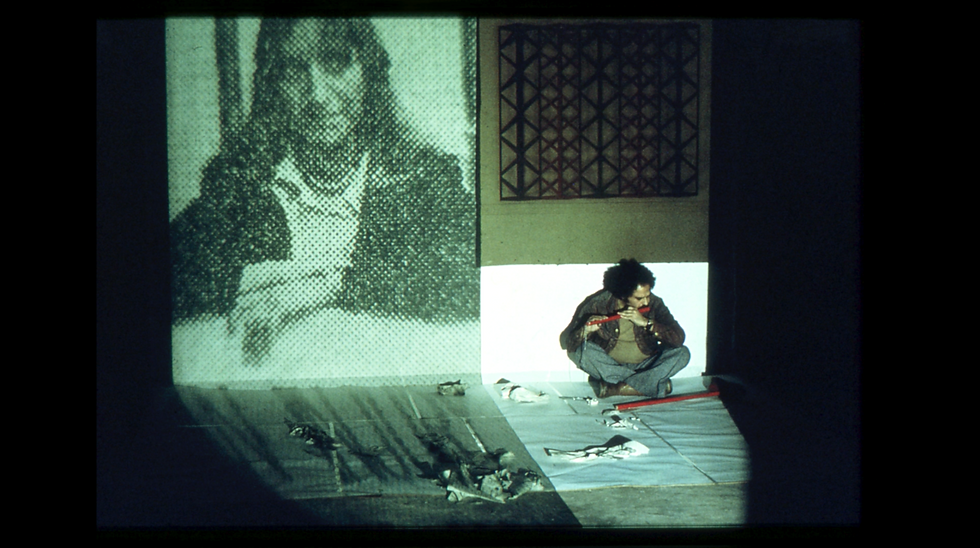
(2) Rasheed Araeen, Paki Bastard, 1977, still image. Courtesy of the artist and Grosvenor Gallery.
NOUR TOURNIER: Your background is in civil engineering. How did this structural rigor and relationship to stability influence your approach to sculpture, and how did you subsequently introduce subjectivity into these geometric forms?
RASHEED ARAEEN: I did indeed train as an engineer, but I wasn't consciously aware of it when I was dedicating myself to art. It was in London, in 1965, that I discovered Anthony Caro's sculpture; I was not only fascinated by it, but it also inspired me to become a sculptor. Until then, I had only practiced painting. Late in 1965, I had the idea of arranging steel girders symmetrically (similar to the ones you might have seen at the Bourse de Commerce), at a time when Minimalism did not yet exist as such.
AUTHOR'S NOTE: Before leaving Karachi, the artist had already been exposed to the avant-garde through imported publications and contacts with the contemporary Pakistani scene, embarking on his first works on paper as early as 1953. Upon settling in London in 1964, Rasheed Araeen was able to translate the logic of construction frameworks—where strength and stability rely on the assembly of horizontal, vertical, and diagonal lines—into the field of sculpture. By 1965, he had developed an unprecedented geometric syntax. His open structures made of wood or brightly painted steel—in shades of red, cobalt blue, yellow, or green—whether wall-mounted like Mon St V (1985) or freestanding like Rang Baranga I (1969), laid the foundations for a rigorous British minimalism. This formal inquiry quickly freed itself from spatial rigidity by opening up to public participation and the movement of elements: the modular manipulation of Zero to Infinity (1968) or the release of sixteen red discs into the waters of St. Katharine Docks in Chakras (1970) initiated an evolving practice. The latter would give rise to the concept of Disco Sailing (1970–1974), a hybrid between floating sculpture and danced performance, revisited as recently as 2019 at the Garage Museum of Contemporary Art in Moscow.
N. T.: When you arrived in London in the 1960s and 1970s, what place did canonical Minimal Art hold in your eyes? How did you position yourself in relation to it, particularly regarding the exclusion of non-Western artists from modernist narratives?
R. A.: When I arrived in London, Minimal Art did not exist. In reality, I pursued my geometric work without any knowledge of New York Minimalism. It was my girlfriend at the time, Elena (who later became my wife), who informed me from Paris in November 1968 about Sol LeWitt's work shown in an exhibition that did not reach London until March 1969. It was at that moment that I became aware of Minimalism as a historical movement and of my place within it. However, I could not position myself within this movement without prior institutional recognition. I remained institutionally excluded from this current, just as the work of all non-white artists was excluded from art history in Britain.
AUTHOR'S NOTE: During the 1970s, institutional conservatism and a political climate hostile to migrants led to the systematic invisibilization of artists of color. Despite a scene bursting with creative radicalism, Araeen repeatedly ran into institutional brick walls. A striking example occurred in 1980 with the Ikon Gallery in Birmingham: invited to participate in a group show, ten artists refused to exhibit alongside him, rejecting his proposal for a ritual performance that involved the slaughter and consumption of a goat alongside tearing up pages from an official art history book. Confronted with such rejections, he threw himself into political and anti-racist organizing within the British Black Panther Movement and Artists for Democracy, drafting his Preliminary Notes for a Black Manifesto in 1975. Through radical multimedia performances (utilizing video, live action, and sound) such as Paki Bastard (1977) or politically charged photomontages, the artist directly confronted gallery spaces over their exclusionary aesthetics and denounced the colonial blind spots of modernist history.
N. T.: How would you describe your artistic interests during the 1990s? How did you experience this turn of the century within your creative practice?
R. A.: In the 1990s, my main activity was the production of the art journal Third Text, which conceptually constituted a collective artwork, up until 2012. During this period, I produced very few other works.
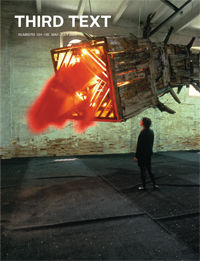
AUTHOR'S NOTE: Viewing writing, criticism, and publishing as indissoluble extensions of his artistic practice, Araeen set out to equip the art scene with decolonial theoretical tools to dismantle the boundary separating creation from critical analysis. Following his experience with Black Phoenix (1978), he founded the academic journal Third Text in 1987 (followed by Third Text Asia in 2008), conceived as a collective conceptual project designed to expose the institutional assimilation of the "exotic other." This intellectual struggle reached a decisive milestone in 1989 when, alongside the Pompidou Centre's Magiciens de la terre, he curated the landmark retrospective The Other Story: Afro-Asian Artists in Post-War Britain at the Hayward Gallery at London's Southbank Centre. By gathering major figures such as Francis Newton Souza, David Medalla, and Li Yuan-chia, Araeen delivered a crucial curatorial statement proving that post-war British modernism had been fundamentally shaped by Asian, African, and Caribbean artists.
N. T.: Between 2000 and 2015, digital technologies transformed artistic production. How do you observe these dynamics in relation to your own practice?
R. A.: I had little artistic interest in digital technology. However, it was useful to me because it allowed me to communicate with others and offered me means of writing.
N. T.: Your work relies on a significant economy of means. Does this refusal of formal excess constitute a strategy of resistance against the fetishization of the commercial art object?
R. A.: I have always opposed the fetishization of the commercial art object, a subject on which I have often written. The economy of means in my work has always been subordinated to my aesthetic and social experience, thereby challenging what you call "formal excess."
N. T.: Canonical minimalism is often described as anti-humanist. Do you feel that your practice, by incorporating social and postcolonial dimensions, helped reintroduce the human subject to the core of minimal aesthetics?
R. A.: When I designed my first symmetric works with geometric forms, my only interest was to create something new, in reaction to and by differentiation from the work of Anthony Caro. As for the question of the humanism or anti-humanism of canonical minimalism, that belongs to criticism and art history, according to which minimalism shifted from the hierarchy of compositional sculpture toward the equality of its symmetrical formation. As far as my own work is concerned, it was an intervention into the historical trajectory of modernism by a postcolonial subject—one to whom colonial discourse denied free subjectivity, and who was thus claiming his humanity, as well as that of others.
RASHEED ARAEEN INTERVIEW


N. T.: How would you describe your artistic interests during the 1990s? How did you experience this turn of the century within your creative practice?
R. A.: In the 1990s, my main activity was the production of the art journal Third Text, which conceptually constituted a collective artwork, up until 2012. During this period, I produced very few other works.
AUTHOR'S NOTE: Viewing writing, criticism, and publishing as indissoluble extensions of his artistic practice, Araeen set out to equip the art scene with decolonial theoretical tools to dismantle the boundary separating creation from critical analysis. Following his experience with Black Phoenix (1978), he founded the academic journal Third Text in 1987 (followed by Third Text Asia in 2008), conceived as a collective conceptual project designed to expose the institutional assimilation of the "exotic other." This intellectual struggle reached a decisive milestone in 1989 when, alongside the Pompidou Centre's Magiciens de la terre, he curated the landmark retrospective The Other Story: Afro-Asian Artists in Post-War Britain at the Hayward Gallery at London's Southbank Centre. By gathering major figures such as Francis Newton Souza, David Medalla, and Li Yuan-chia, Araeen delivered a crucial curatorial statement proving that post-war British modernism had been fundamentally shaped by Asian, African, and Caribbean artists.
N. T.: Between 2000 and 2015, digital technologies transformed artistic production. How do you observe these dynamics in relation to your own practice?
R. A.: I had little artistic interest in digital technology. However, it was useful to me because it allowed me to communicate with others and offered me means of writing.
N. T.: Your work relies on a significant economy of means. Does this refusal of formal excess constitute a strategy of resistance against the fetishization of the commercial art object?
R. A.: I have always opposed the fetishization of the commercial art object, a subject on which I have often written. The economy of means in my work has always been subordinated to my aesthetic and social experience, thereby challenging what you call "formal excess."
N. T.: Canonical minimalism is often described as anti-humanist. Do you feel that your practice, by incorporating social and postcolonial dimensions, helped reintroduce the human subject to the core of minimal aesthetics?
R. A.: When I designed my first symmetric works with geometric forms, my only interest was to create something new, in reaction to and by differentiation from the work of Anthony Caro. As for the question of the humanism or anti-humanism of canonical minimalism, that belongs to criticism and art history, according to which minimalism shifted from the hierarchy of compositional sculpture toward the equality of its symmetrical formation. As far as my own work is concerned, it was an intervention into the historical trajectory of modernism by a postcolonial subject—one to whom colonial discourse denied free subjectivity, and who was thus claiming his humanity, as well as that of others.
N. T.: How would you describe your artistic interests during the 1990s? How did you experience this turn of the century within your creative practice?
R. A.: In the 1990s, my main activity was the production of the art journal Third Text, which conceptually constituted a collective artwork, up until 2012. During this period, I produced very few other works.
AUTHOR'S NOTE: Viewing writing, criticism, and publishing as indissoluble extensions of his artistic practice, Araeen set out to equip the art scene with decolonial theoretical tools to dismantle the boundary separating creation from critical analysis. Following his experience with Black Phoenix (1978), he founded the academic journal Third Text in 1987 (followed by Third Text Asia in 2008), conceived as a collective conceptual project designed to expose the institutional assimilation of the "exotic other." This intellectual struggle reached a decisive milestone in 1989 when, alongside the Pompidou Centre's Magiciens de la terre, he curated the landmark retrospective The Other Story: Afro-Asian Artists in Post-War Britain at the Hayward Gallery at London's Southbank Centre. By gathering major figures such as Francis Newton Souza, David Medalla, and Li Yuan-chia, Araeen delivered a crucial curatorial statement proving that post-war British modernism had been fundamentally shaped by Asian, African, and Caribbean artists.
N. T.: Between 2000 and 2015, digital technologies transformed artistic production. How do you observe these dynamics in relation to your own practice?
R. A.: I had little artistic interest in digital technology. However, it was useful to me because it allowed me to communicate with others and offered me means of writing.
N. T.: Your work relies on a significant economy of means. Does this refusal of formal excess constitute a strategy of resistance against the fetishization of the commercial art object?
R. A.: I have always opposed the fetishization of the commercial art object, a subject on which I have often written. The economy of means in my work has always been subordinated to my aesthetic and social experience, thereby challenging what you call "formal excess."
N. T.: Canonical minimalism is often described as anti-humanist. Do you feel that your practice, by incorporating social and postcolonial dimensions, helped reintroduce the human subject to the core of minimal aesthetics?
R. A.: When I designed my first symmetric works with geometric forms, my only interest was to create something new, in reaction to and by differentiation from the work of Anthony Caro. As for the question of the humanism or anti-humanism of canonical minimalism, that belongs to criticism and art history, according to which minimalism shifted from the hierarchy of compositional sculpture toward the equality of its symmetrical formation. As far as my own work is concerned, it was an intervention into the historical trajectory of modernism by a postcolonial subject—one to whom colonial discourse denied free subjectivity, and who was thus claiming his humanity, as well as that of others.
(1) Rasheed Araeen, the original 'First Structure' (1987), before it was destroyed
COURTESY OF GROSVENOR GALLERY AND THE ARTIST WITH PERMISSION FOR VARSITY
(2) Rasheed Araeen, Paki Bastard, 1977, still image. Courtesy of the artist and Grosvenor Gallery.
AUTHOR'S NOTE: The recurring use of dynamic crossed diagonals, motifs drawn from Sufi geometry, or a vibrant green directly linked to the Pakistani flag set Araeen's work apart from standard Western minimalist canons. Araeen's practice shuns mere visual spectacle in favor of a systematic challenge to Euro-American definitions of aesthetic value. His international trajectory has been highlighted in major global exhibitions, including the 2nd Johannesburg Biennale (1997), the 11th Biennale of Sydney (1998), the Shanghai and Gwangju biennales (2012), the 57th Venice Biennale (2017), and documenta 14 (2017).
N. T.: Do you believe art must be intrinsically political, or can structure be self-sufficient?
R. A.: Art has always been political, whether negatively or positively, explicitly or implicitly. In my case, the minimal work was not politically sufficient, because it was not institutionally allowed to enter the discourse through which it could have asserted itself ideologically.
N. T.: In retrospect, what are your thoughts on the label "Minimalist"? Do you consider it a structural foundation or a term historically too narrow to encompass the theoretical scope of your work?
R. A.: The label "Minimalist" presents a problem for me. Minimalism having been historically recognized as an American achievement, my work (once recognized as minimalist) would become subordinate to that American discourse and understanding. It requires its own body of research that would historically associate my work with minimalism while simultaneously distinguishing it from it.
N. T.: Do you see any legitimate heirs to the conceptual rigor of minimalism on the contemporary scene, or do you feel it has become a simple decorative aesthetic stripped of its original critical charge?
R. A.: Minimalism is in fact trapped in the impasse of its own formalism, as well as in an imperial American chauvinism, rather than carrying a vision of equality for all humanity.

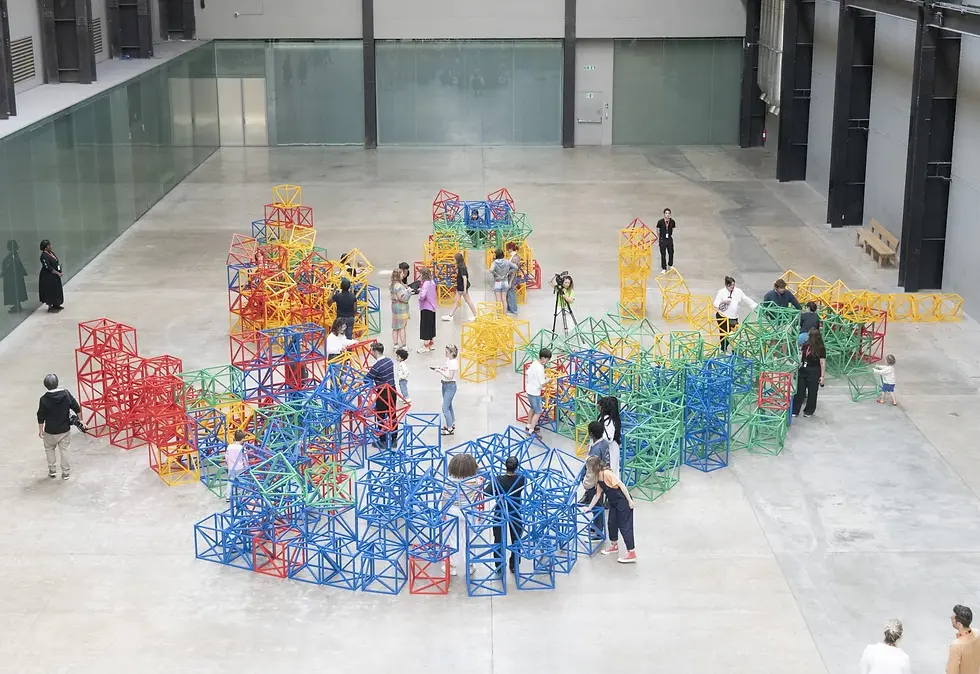
(1) The Other Story: Afro-Asian Artists in Post-War Britain, Hayward Gallery, 1989-1990, installation photograph. Digital image courtesy of Rasheed Araeen and Asia Art Archive.
(2) Rasheed Araeen, Zero to Infinity à la Tate Modern, 2023, dans le cadre d’UNIQLO Tate Play, Ph. © Tate (Lucy Green)
N. T.: How did you approach the dialogue between your works and those of your contemporaries (such as Judd or Andre) within the institution?
R. A.: My work can maintain a dialogue with Judd or Andre, but only on a formal level. Conceptually, it goes beyond this dialogue. In 1968, I broke its formal structure, and the work became a continuous and open process involving public participation (see my book Art Beyond Art).
AUTHOR'S NOTE: Throughout the 2000s and 2010s, the artist continued his deconstruction of museum spaces and the art market, articulating his critique of art institutions in essays such as The Museum as Arena (published by Kunsthaus Bregenz in 2001). Informed by frequent return visits to Pakistan and observations in Balochistan, he formalized the concept of "Eco-aesthetics" in his 2010 book Art Beyond Art, advocating for a radical shift away from passive contemplation toward art integrated into social life. This philosophy found concrete expression in his major retrospective spanning sixty years of work (comprising 126 objects), launched at the Van Abbemuseum in Eindhoven in late 2017 before touring to MAMCO in Geneva, the BALTIC in Gateshead, and the Garage Museum in Moscow. There, his geometric structures were occasionally repurposed as functional tables holding issues of Third Text. This relational approach culminated in 2019 with the opening of Shamiyaana in Stoke Newington, London—a community restaurant space designed by the artist where formal aesthetics yield to hospitality, conversation, and shared affordable meals.
N. T.: What importance do you attribute today to this form of re-institutionalization of minimalism, and what message does it send about the place of subjectivity in 21st-century art?
R. A.: Historically and ideologically, it is more important to deinstitutionalize not only minimalism, but art itself (see again Art Beyond Art). The subtitle of that book is, after all: Eco-Aesthetics: A Manifesto for the 21st Century.
CQFD.
N. T.: How did you approach the dialogue between your works and those of your contemporaries (such as Judd or Andre) within the institution?
R. A.: My work can maintain a dialogue with Judd or Andre, but only on a formal level. Conceptually, it goes beyond this dialogue. In 1968, I broke its formal structure, and the work became a continuous and open process involving public participation (see my book Art Beyond Art).
AUTHOR'S NOTE: Throughout the 2000s and 2010s, the artist continued his deconstruction of museum spaces and the art market, articulating his critique of art institutions in essays such as The Museum as Arena (published by Kunsthaus Bregenz in 2001). Informed by frequent return visits to Pakistan and observations in Balochistan, he formalized the concept of "Eco-aesthetics" in his 2010 book Art Beyond Art, advocating for a radical shift away from passive contemplation toward art integrated into social life. This philosophy found concrete expression in his major retrospective spanning sixty years of work (comprising 126 objects), launched at the Van Abbemuseum in Eindhoven in late 2017 before touring to MAMCO in Geneva, the BALTIC in Gateshead, and the Garage Museum in Moscow. There, his geometric structures were occasionally repurposed as functional tables holding issues of Third Text. This relational approach culminated in 2019 with the opening of Shamiyaana in Stoke Newington, London—a community restaurant space designed by the artist where formal aesthetics yield to hospitality, conversation, and shared affordable meals.
N. T.: What importance do you attribute today to this form of re-institutionalization of minimalism, and what message does it send about the place of subjectivity in 21st-century art?
R. A.: Historically and ideologically, it is more important to deinstitutionalize not only minimalism, but art itself (see again Art Beyond Art). The subtitle of that book is, after all: Eco-Aesthetics: A Manifesto for the 21st Century.
CQFD.
© DORIAN LAFARGUE